Topic Momentum Forecasts Which Astronomy Questions the Field Takes Up: Five Pre-registered Out-of-Time Backtests and a Sealed 2026–2031 Forecast
Published 2026-10-16 · Version 4 · Astronomy & Astrophysics · CC-BY-4.0
Research object
Introduction
Systems that propose scientific questions are usually judged by how good the questions look to a person or a model. A more demanding standard asks whether the field actually went where the questions point. Historical backtesting turns that standard into a measurement (Mao 2026b):
generate questions from literature published before a cutoff;
freeze them;
- label each one by what the following years of literature did with it.
The third paper in this series (Mao 2026d) used the protocol to fit a predictor of future attention on 980 astronomy questions at cutoffs 2012–2020. It reported a temporal-split AUC of 0.71.
A predictor tuned on a fixed set of cutoffs can look good for reasons that do not survive time. This paper asks whether the forecast holds up when it is made the way a forecaster would actually have made it: at a cutoff the model never saw, trained only on outcomes that were already known on that day, and scored before anyone looks at the answers.
Contributions.
Out-of-time replication. Paper 3’s predictor transfers to five new cutoffs (pooled AUC 0.655 over 995 questions). Most of that skill, however, is a generation-source prior (§5.1).
Topic momentum. A dense-retrieval measure of how much, and how recently, the field was already publishing near a question is the strongest single predictor we found. Combined with the question’s embedding (v3), it reaches AUC 0.77 and within-source AUC 0.69 on fresh cutoffs, under pre-registered tests (§5.3).
Three validity checks. We test the forecast against a citation-graph outcome that bypasses text retrieval, against questions written with no language model, and against human judgments (§6). It survives all three.
A measurement finding. The strict LLM judge behind the series’ labels is far stricter than humans, and humans barely agree with each other. Absolute outcome rates are therefore rater-relative, and LLM-phrased questions inflate them further (§6.3).
- A sealed forecast. 200 questions posed on 2026-10-14 are scored by three model versions, frozen, and due for scoring after 2031-10-15 (§7).
Related work
Forecasting the direction of science.
Embeddings trained on past literature can anticipate future findings: word embeddings of materials-science abstracts ranked compounds that were later reported for a property years before publication (Tshitoyan et al. 2019). Semantic networks built from past papers predict which concept pairs will be studied together in quantum physics (Krenn and Zeilinger 2020) and in AI (Krenn et al. 2023). Human-aware models that account for who can make a connection forecast discoveries better than content-only models (Sourati and Evans 2023). Our task differs from all of these in three ways:
the unit is a natural-language research question, not a concept pair or material;
the outcome is substantive engagement, judged from later papers;
- every evaluation is pre-registered and out of time.
Predictability in the science of science.
The science of science has long studied what can and cannot be predicted about papers and careers (Clauset, Larremore, and Sinatra 2017), for example long-term citation impact (Wang, Song, and Barabási 2013). We predict uptake of questions, a step earlier than impact. Our momentum features are close in spirit to field-growth predictors, but they are measured per question.
LLM-generated ideas and LLM judges.
Expert evaluation finds LLM-generated research ideas judged more novel but less feasible than human ones (Si, Yang, and Hashimoto 2024). Our backtests replace expert opinion with observed outcomes, but they rely on an LLM judge. Known judge biases (Zheng et al. 2023) and our own human comparison (§6.3) make that judge a measured instrument rather than ground truth.
This series.
Paper 1 (Mao 2026a) generates questions from tensions in an evidence graph. Paper 2 (Mao 2026b) formalises historical backtesting and includes a blinded two-annotator study that we reuse. Paper 3 (Mao 2026d) provides the 980-question training set, the six feature groups, the label pipeline and the v1 model. Paper 4 (Mao 2026c) ranks next evidence-gathering actions for a question. All upstream code and data are vendored unmodified at pinned commits.
Pre-registration.
Freezing hypotheses and analysis plans before seeing outcomes (Nosek et al. 2018) is the main defence against tuning to the test set. We apply it to forecasting: the forecast itself is frozen and its digest published before the outcomes are computed.
Setup
Corpus.
We harvested arXiv astro-ph metadata, including cross-lists, from 2005 to 2026-10-14 through OAI-PMH: 332,244 papers. The publication date is the version-1 date. The per-year counts match Paper 3’s independent harvest: identical for 2007–2021 and within 0.06% elsewhere. Paper 3’s keyword rules assign papers to eight subfields:
exoplanet atmospheres;
protoplanetary disks;
stellar activity;
fast radio bursts;
gravitational waves;
galaxy evolution;
cosmology tensions;
- compact objects.
The 106,428 subfield papers are embedded with text-embedding-3-small.
Questions.
For every cutoff and subfield, Paper 3’s generators produce 25 questions from the preceding eight years of abstracts only:
10 evidence-tension questions, from clusters of contradiction statements across at least two papers (Paper 1’s approach);
5 direct-LLM questions;
5 author future-work questions;
- 5 weak or negative controls.
Phrasing uses gpt-4o-mini. The five test cutoffs yield 995 questions; one small 2017 cell produced only 5 tension clusters.
Outcome label.
A question is addressed if, among the top-8 post-cutoff papers of its subfield retrieved by TF-IDF, Paper 3’s strict judge (gpt-4o) finds at least one that engages it directly and assigns an outcome other than not_addressed.
The outcome windows are:
five years for the 2017 and 2019 cutoffs;
- to 2026-10-14 for the later cutoffs: 4.79, 3.79 and 2.79 years for 2021, 2022 and 2023.
Base rates range from 0.495 to 0.605.
Leak-free training.
Each test cohort is scored by models fitted only on Paper 3 questions whose outcome windows had closed by the test cutoff:
| Test cutoff | Training cutoffs |
|---|---|
| 2017 | 2012 |
| 2019 | 2012, 2014 |
| 2021, 2022 | 2012, 2014, 2016 |
| 2023 | 2012, 2014, 2016, 2018 |
A model trained on later labels would see field dynamics from inside the test window.
Pre-registration and freezing.
Each round’s hypotheses, metrics and decision rules were committed to the public repository before that round’s questions were generated. Questions, features and predictions were then frozen with SHA-256 digests and pushed before labelling. Models were designed only on cohorts whose labels had already been seen:
v2 on the 2021 cohort;
- v3 on 2019, 2021 and 2022, plus leave-one-cutoff-out on Paper 3.
Confirmatory claims use only cohorts generated afterwards. Bootstrap intervals use 2,000 resamples stratified by cohort × source. Within-source AUC is the mean AUC over cohort × source strata that contain both outcome classes.
Models
v1: Paper 3’s model.
This is a logistic regression on six groups of cutoff-time features: text, evidence context, novelty, falsifiability, tractability and field environment. Our vendored copy reproduces Paper 3’s published temporal-split AUC exactly (0.7126).
v2: embedding with a source fixed effect.
This is a logistic regression on the question’s embedding plus one-hot generation source. The fixed effect forces the remaining features to explain variation within a source. C is chosen by leave-one-cutoff-out AUC on the training set. A calibrated variant averages its log-odds with v1’s features (plus the source effect) and applies Platt scaling on out-of-fold predictions.
v3: adding topic momentum.
For each question we compute cosine similarities between its embedding and every paper of its subfield in the eight-year past window, and derive nine features:
mean similarity of the 10 and the 50 nearest papers;
log-counts of papers above two similarity thresholds (0.58 and 0.65, set from the feature distribution, not from outcomes);
that count as a share of the subfield;
the share of the 50 nearest papers from the last two years;
the mean age of the 20 nearest papers;
the log-ratio of near papers in the last two years to the two years before;
- the count of near papers in the last two years.
v3 averages the log-odds of a momentum-plus-source logistic model and v2’s embedding model, with the same Platt calibration. Its training cohorts never include the test cutoff.
Results
The original predictor transfers, but mostly as a source prior
At cutoff 2021, the first round, v1 scored AUC 0.656 [0.583, 0.733], against 0.71 within its own era:
it beat a subfield-popularity baseline by +0.102 [0.039, 0.167];
it did not beat a one-number-per-source prior (-0.024 [-0.109, 0.073]);
- its within-source AUC was 0.569 [0.496, 0.650].
Across all five cutoffs v1 is stable (Table 1): pooled AUC 0.630–0.693. Its ranking of direct-LLM questions is at or below chance (pooled 0.44), because those questions are engaged almost regardless of content.
| Cutoff (n) | v1 (Paper 3) | source prior | v2 | v3 |
|---|---|---|---|---|
| 2017 (195) | 0.630 / 0.577 | 0.628 / 0.50 | 0.674 / 0.594 | 0.728 / 0.634 |
| 2019 (200) | 0.654 / 0.548 | 0.667 / 0.50 | 0.730 / 0.642 | 0.765 / 0.703 (dev) |
| 2021 (200) | 0.656 / 0.569 | 0.680 / 0.50 | 0.745 / 0.646 (dev) | 0.784 / 0.704 (dev) |
| 2022 (200) | 0.677 / 0.648 | 0.667 / 0.50 | 0.747 / 0.650 | 0.776 / 0.687 (dev) |
| 2023 (200) | 0.693 / 0.609 | 0.758 / 0.50 | 0.827 / 0.738 | 0.845 / 0.753 |
| All (995) | 0.655 / 0.590 | 0.686 / 0.500 | 0.738 / 0.654 | 0.771 / 0.696 |
AUC by cutoff, as pooled / within-source, under Paper 3’s label. Each cohort is scored by models trained only on labels closed by its cutoff. dev marks cohorts a model was designed on. Bold marks fresh tests of v3.
An embedding model beats the source prior
On the fresh 2019 and 2022 cohorts (n=400), v2 was tested against pre-registered hypotheses:
pooled AUC 0.737 against the source prior’s 0.669, a gain of +0.068 [0.019, 0.117];
within-source AUC 0.646 [0.583, 0.710];
AUC 0.606 [0.515, 0.694] within evidence-tension questions;
- Brier score 0.207, against v1’s 0.240 and the constant’s 0.248.
Its within-source gain over v1 (+0.048) was not significant. v1 also scored above chance within sources on these cohorts (0.598), so part of round 1’s within-source failure was specific to the 2021 cohort.
Topic momentum: the strongest predictor
Table 2 reports the round-3 tests on the fresh 2017 and 2023 cohorts (n=395, base rate 0.51). v3:
ranks within a source at 0.694 (T1);
beats v1 within a source by +0.101 (T3);
beats the source prior by +0.081 (T4);
ranks evidence-tension questions at 0.692 (T6);
- has the best Brier score (T5).
Its within-source gain over v2, +0.028 [-0.008, 0.062], misses significance (T2). Across all five cutoffs v3 is the best model on both measures in every cohort (Table 1). The momentum model alone reaches pooled AUC 0.770 on the fresh cohorts. Its strongest contribution is inside evidence-tension questions: 0.738, against 0.599 for v2.
| ID | Hypothesis | Result |
|---|---|---|
| T1 | v3 ranks within a source | AUC 0.694 [0.612, 0.771] |
| T2 | v3 > v2 within a source | Δ=+0.028 [-0.008, 0.062], not significant |
| T3 | v3 > v1 within a source | Δ=+0.101 [0.027, 0.176] |
| T4 | v3 > source prior (pooled) | 0.769 vs 0.688; Δ=+0.081 [0.042, 0.123] |
| T5 | Brier(v3) < Brier(v2) | 0.191 vs 0.206 (v1 0.253) |
| T6 | v3 ranks evidence-tension questions | AUC 0.692 [0.604, 0.773] |
Round 3: pre-registered tests on the fresh 2017 and 2023 cohorts.
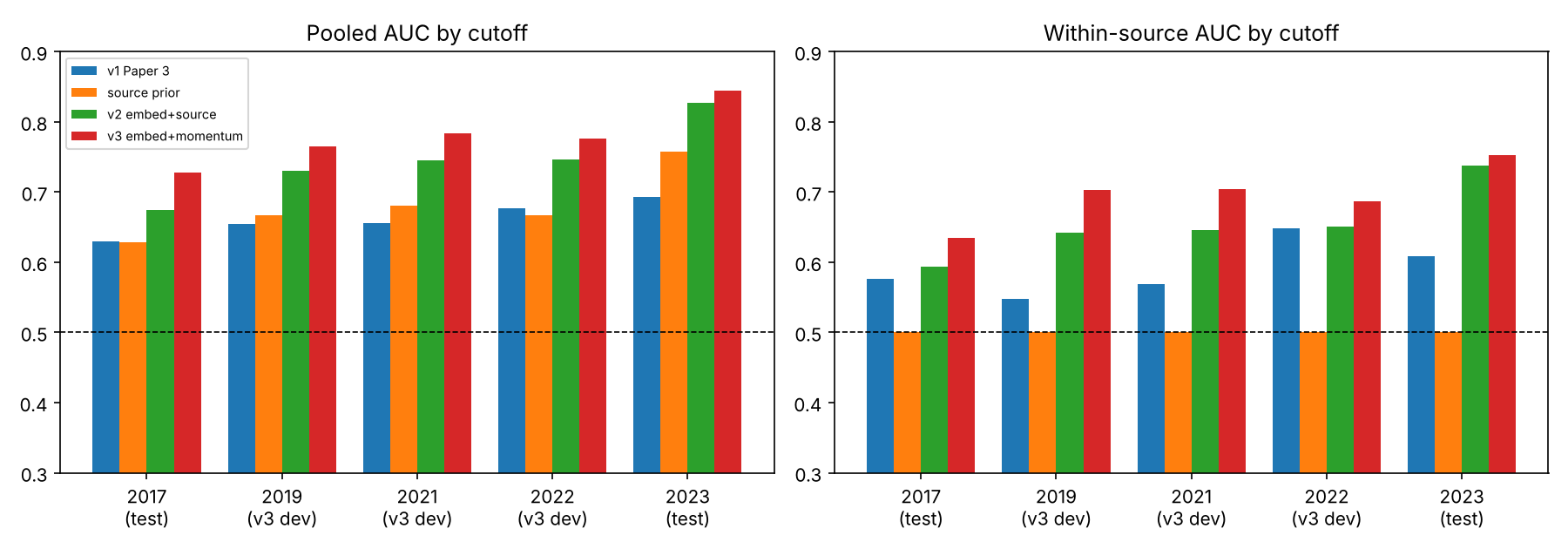
Pooled (left) and within-source (right) AUC at each cutoff. Cohorts marked dev were used to design v3; 2017 and 2023 are fresh tests.
Validity checks
Figure 2 summarises v3’s skill under every check in this section.
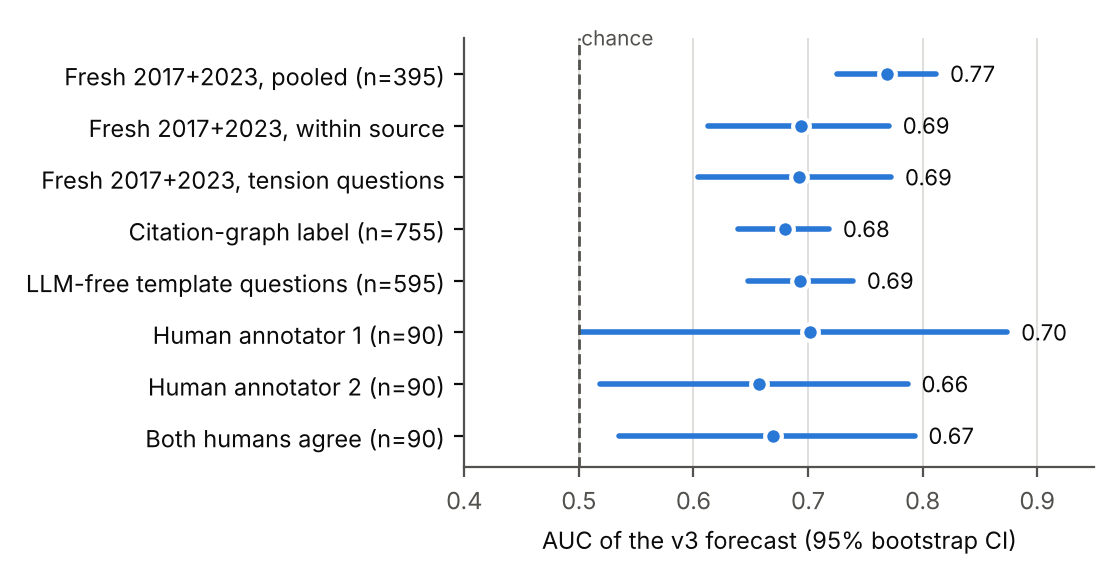
v3’s AUC, with 95% bootstrap intervals, on the fresh test cohorts and under the three validity checks: a retrieval-independent citation label, LLM-free questions, and human annotators.
Is momentum just predicting the retriever?
The outcome label finds future papers by TF-IDF similarity, and momentum counts past papers similar to the question. Momentum could therefore predict the retriever instead of the field.
We built a second label whose candidates are post-cutoff papers that cite the question’s source papers, taken from the Semantic Scholar citation graph (1,213 of 1,214 source papers). It is judged by the same gpt-4o rubric. It is defined for the 755 questions that have source papers, across all five cutoffs, and agrees with the TF-IDF label on 73% of them.
On this label:
v3 scores AUC 0.680 [0.639, 0.718];
the momentum model alone scores 0.689 [0.650, 0.730], almost unchanged from its 0.699 on the TF-IDF label;
- v1 falls from 0.614 to 0.569.
Momentum tracks where the field went, not how the retriever works.
Did the question generator leak the future?
The generator (gpt-4o-mini) has read literature from after every backtest cutoff. To test whether that matters, we pre-registered and built 595 questions with no language model: the same tension clusters and future-work sentences, inserted verbatim into fixed templates. Each of the 395 tension templates shares its evidence cluster with exactly one LLM-phrased question.
v3’s skill holds. It scores 0.693 [0.648, 0.739] pooled and 0.704 [0.657, 0.750] within template type.
LLM phrasing inflates outcome rates. On the same 395 clusters, the LLM-phrased question is addressed 44.6% of the time and the template 28.6%: +16.0 points [10.9, 21.0].
- The ranking does not depend on phrasing. v3’s AUC is 0.726 on the templates against 0.679 on their LLM-phrased twins (Δ=+0.047 [-0.032, 0.121]).
Absolute outcome rates of LLM-generated questions should therefore not be quoted as properties of the questions. Rankings are unaffected.
Do the forecasts predict human judgment?
Paper 2’s blinded study had two annotators label 90 questions (cutoff 2020), each shown the same eight post-cutoff abstracts a judge sees. We ran Paper 3’s judge on those items.
The judge and the humans disagree:
humans call 90% and 73% of the questions addressed;
the strict
gpt-4ojudge calls 43% addressed;agreement with each human is κ=-0.00 and 0.14;
- the two humans agree with each other at only κ=0.11 [-0.08, 0.32].
We also checked that the judge itself is stable. Re-judging 120 of Paper 3’s own questions today, gpt-4o reproduces the committed labels (κ=0.83, identical 50.8% rate). gpt-4o-mini, the pipeline’s code default, calls 93% addressed (κ=0.14).
Scored with v3 trained only on cutoffs that closed by 2020, the 90 questions’ forecasts predict:
human 1, AUC 0.702 [0.502, 0.874];
human 2, 0.657 [0.518, 0.787];
questions both humans call addressed, 0.669 [0.535, 0.793];
- the
gpt-4ojudge on the same items, only 0.548.
The forecast signal therefore reaches human judgment and is not an artefact of the judge’s rubric. This analysis was not pre-registered, and n=90 is small.
Negative result: the evidence planner
Paper 4’s planner ranks next evidence-gathering actions. Its top-k utility does not predict uptake: AUC 0.419 [0.305, 0.537] within tension questions at cutoff 2021, replicating Paper 4’s own retraction.
Its top-ranked action is nearly constant. Under the default configuration it recommends a simulation for 41 of the 42 questions that were followed up. Under the Paper-3-informed configuration it recommends a literature review for all of them. It matches the action the field actually took (classified by gpt-4o) at 0.60, against a permutation null of 0.61 (p=1.0).
A sealed 2026–2031 forecast
On 2026-10-14 we generated 200 new questions with the same generators and scored them with v1, v2 and v3. Each version’s scores are frozen separately (FREEZE*.json). They will be labelled with the same pipeline over 2026-10-15 to 2031-10-14, no earlier than 2031-10-15. The pre-registered claims are:
AUC >0.5;
- the top quintile is addressed more often than the bottom quintile.
Paper 2’s 200 questions, frozen on 2026-08-17, are scored the same way.
The forecast is about uptake, not answers. A score of 0.75 means the model expects at least one post-cutoff paper to engage the question directly and substantively, with new evidence, a test or a resolution attempt. It makes no claim about what that work will find, or whether the question will be settled. Resolutions are too rare in the historical labels (8 of Paper 3’s 980 questions) for that to be forecastable at this scale.
v3’s mean forecast is highest for fast radio bursts (0.62) and cosmology tensions (0.60), and lowest for stellar activity (0.42). Among the evidence-tension questions, the top-ranked concern:
the Hubble-constant discrepancy and early-dark-energy resolutions (0.65–0.75);
the abundance of luminous z>10 galaxies seen by JWST (0.70–0.75);
magnetar and merger-remnant origins of fast radio bursts (0.65–0.73);
- the ~2.5 M⊙ object in GW190814 and the black-hole mass gap (0.66–0.67).
The lowest-ranked are narrow object-level discrepancies (0.19–0.28), such as retrieved C/O ratios of Gliese 229 B or spot coverage of HAT-P-12.
Limitations and deviations
The label is an instrument, not ground truth. “Addressed” means addressed according to a strict
gpt-4orubric over abstract-level retrieval. Human annotators are both more lenient and mutually inconsistent. Our human check (n=90) supports the forecast’s validity but is underpowered.Shorter windows at recent cutoffs. The 2021–2023 cohorts have outcome windows of 2.8–4.8 years, against five years for Paper 3.
One domain, one corpus. Astronomy only, arXiv only, eight keyword-defined subfields.
Generator leakage. It affects outcome rates (+16 points) but not the ranking. Remaining embedding-model leakage was not tested separately.
Deviations from pre-registration, all disclosed in the repository.
Round 1 named the wrong judge model: the code default
gpt-4o-miniinstead ofgpt-4o, which made Paper 3’s labels. We report both and use the latter.The citation label was delayed by API rate limits, and its round-1 analyses are exploratory.
- v2 received the single-training-cutoff rule pre-stated for v3, to be scorable at 2017. This leaves multi-cutoff predictions byte-identical.
- T2 failed. v3’s within-source improvement over v2 is not significant. Its advantage is significant against v1 and the source prior.
Conclusion
Across five pre-registered out-of-time cutoffs, a forecaster built from this series’ components predicts which astronomy questions the field will take up. The decisive ingredient is not the structure of the question but topic momentum: whether the field was already moving toward it at the cutoff.
The forecast survives three checks:
an outcome label that bypasses text retrieval;
questions no language model wrote;
- human judgment.
The work also measures, rather than assumes, how much its LLM instruments shape absolute rates.
The sealed 2026–2031 forecast is the test no backtest can replace. Every model that exists today will be scored on literature none of them has seen.
Data and code.
https://github.com/nonameisready/scientific-discovery-astronomy. This contains:
pre-registrations
docs/PREREGISTRATION*.md;frozen predictions and digests (
data/*/FREEZE*.json);labels and LLM caches;
- scripts reproducing every number in this paper.
Timeline of commits
Each step below is a public commit, so the order is verifiable.
| Commit | Step |
|---|---|
bcf8469 | Round-1 pre-registration (cutoff 2021), before any question |
60f0f5d | 2021 cohort and predictions frozen, before any label |
a4eea0f | Round-2 pre-registration and v2 models |
bd84ebc, 58fe4b7 | 2022 and 2019 cohorts frozen |
18665c2 | Round-3 pre-registration, v3 and momentum features |
d17b821 | 2017 and 2023 cohorts frozen (v1, v2, v3) |
566b4d9, 7327dc8 | Round-4 pre-registration; template questions frozen |
Clauset, Aaron, Daniel B. Larremore, and Roberta Sinatra. 2017. “Data-Driven Predictions in the Science of Science.” Science 355 (6324): 477–80. https://doi.org/10.1126/science.aal4217.
Krenn, Mario, Lorenzo Buffoni, Bruno Coutinho, Sagi Eppel, Jacob Gates Foster, Andrew Gritsevskiy, Harlin Lee, et al. 2023. “Forecasting the Future of Artificial Intelligence with Machine Learning-Based Link Prediction in an Exponentially Growing Knowledge Network.” Nature Machine Intelligence 5 (11): 1326–35. https://doi.org/10.1038/s42256-023-00735-0.
Krenn, Mario, and Anton Zeilinger. 2020. “Predicting Research Trends with Semantic and Neural Networks with an Application in Quantum Physics.” Proceedings of the National Academy of Sciences 117 (4): 1910–16. https://doi.org/10.1073/pnas.1914370116.
Mao, Hui. 2026a. “Evidence-Based Scientific Question Discovery: A Framework with Historical Backtesting.” arXiv Preprint arXiv:2608.09968.
———. 2026b. “Historical Backtesting for Scientific Question Discovery: A Protocol and Astronomy Pilot.” arXiv Preprint arXiv:2608.16795.
———. 2026c. “Planning the Next Evidence Acquisition Step: An Offline Framework for Active Scientific Discovery.” OpenFindings, https://openfindings.org/papers/or:2026:f35059ae.
———. 2026d. “What Makes a Scientific Question Succeed? Predicting Future Attention, Resolution, and Premise Revision from Question Structure and Evidence Context.” OpenFindings, https://openfindings.org/papers/or:2026:3eab2db2.
Nosek, Brian A., Charles R. Ebersole, Alexander C. DeHaven, and David T. Mellor. 2018. “The Preregistration Revolution.” Proceedings of the National Academy of Sciences 115 (11): 2600–2606. https://doi.org/10.1073/pnas.1708274114.
Si, Chenglei, Diyi Yang, and Tatsunori Hashimoto. 2024. “Can LLMs Generate Novel Research Ideas? A Large-Scale Human Study with 100+ NLP Researchers.” arXiv Preprint arXiv:2409.04109.
Sourati, Jamshid, and James A. Evans. 2023. “Accelerating Science with Human-Aware Artificial Intelligence.” Nature Human Behaviour 7 (10): 1682–96. https://doi.org/10.1038/s41562-023-01648-z.
Tshitoyan, Vahe, John Dagdelen, Leigh Weston, Alexander Dunn, Ziqin Rong, Olga Kononova, Kristin A. Persson, Gerbrand Ceder, and Anubhav Jain. 2019. “Unsupervised Word Embeddings Capture Latent Knowledge from Materials Science Literature.” Nature 571 (7763): 95–98. https://doi.org/10.1038/s41586-019-1335-8.
Wang, Dashun, Chaoming Song, and Albert-László Barabási. 2013. “Quantifying Long-Term Scientific Impact.” Science 342 (6154): 127–32. https://doi.org/10.1126/science.1237825.
Zheng, Lianmin, Wei-Lin Chiang, Ying Sheng, Siyuan Zhuang, Zhanghao Wu, Yonghao Zhuang, Zi Lin, et al. 2023. “Judging LLM-as-a-Judge with MT-Bench and Chatbot Arena.” arXiv Preprint arXiv:2306.05685.
Appendix: the sealed 2026–2031 forecast (all 200 questions)
Questions posed on 2026-10-14 from the preceding eight years of arXiv astro-ph. Each probability is that the question will be substantively engaged by astro-ph papers published 2026-10-15 to 2031-10-14 (Paper 3's label: top-8 TF-IDF-retrieved papers of the subfield, strict gpt-4o judge). It is a forecast of uptake, not of answers or resolution. Ranked by v3; v2 and v1 are shown for the 2031 comparison. Frozen with SHA-256 digests: FREEZE.json (v1), FREEZE_v2.json, FREEZE_v3.json. Machine-readable copy: forecast.csv (raw).
| # | p (v3) | p (v2) | p (v1) | subfield | source | question |
|---|---|---|---|---|---|---|
| 1 | 0.97 | 0.96 | 0.86 | fast_radio_bursts | direct_llm | How do the host galaxy environments influence the dispersion measures and scattering properties of fast radio bursts? |
| 2 | 0.97 | 0.96 | 0.79 | fast_radio_bursts | direct_llm | What role do baryonic feedback processes play in the observed characteristics of fast radio bursts and their host galaxies? |
| 3 | 0.97 | 0.97 | 0.94 | cosmology_tensions | direct_llm | How can we resolve the Hubble tension between local measurements and those derived from the cosmic microwave background? |
| 4 | 0.96 | 0.94 | 0.85 | protoplanetary_disks | direct_llm | What role do magnetic fields play in the evolution of protoplanetary disks and the formation of planets within them? |
| 5 | 0.95 | 0.91 | 0.79 | compact_objects | direct_llm | How do the properties of neutron stars, such as their maximum densities and equation of state, vary with different nuclear interactions, and what implications does this have for our understanding of dense matter? |
| 6 | 0.95 | 0.95 | 0.92 | exoplanet_atmospheres | direct_llm | What are the long-term stability and evolution of atmospheres on rocky exoplanets, particularly those in the habitable zone, under varying stellar activity and environmental conditions? |
| 7 | 0.93 | 0.85 | 0.71 | gravitational_waves | direct_llm | What are the effects of eccentricity in binary black hole mergers on gravitational wave signals, and how can we accurately infer parameters from these systems in the presence of eccentric companions? |
| 8 | 0.93 | 0.93 | 0.86 | compact_objects | direct_llm | How do gravitational wave signals from binary neutron star mergers inform us about the internal structure and composition of neutron stars, particularly in relation to phenomena like strange quark matter? |
| 9 | 0.93 | 0.90 | 0.79 | exoplanet_atmospheres | direct_llm | What are the specific mechanisms driving atmospheric escape in ultra-hot Jupiters, and how do these processes vary with different stellar environments? |
| 10 | 0.93 | 0.89 | 0.69 | stellar_activity | direct_llm | How do varying levels of stellar magnetic activity influence the atmospheric composition and habitability of exoplanets orbiting M dwarfs and other cool dwarf stars? |
| 11 | 0.93 | 0.96 | 0.94 | cosmology_tensions | direct_llm | What is the precise nature of dark energy, and how can we distinguish between different models of dark energy dynamics? |
| 12 | 0.93 | 0.85 | 0.36 | galaxy_evolution | direct_llm | What are the physical conditions and processes that lead to the formation of massive compact quiescent galaxies, and how do they relate to the overall galaxy mass function? |
| 13 | 0.92 | 0.93 | 0.80 | galaxy_evolution | direct_llm | What is the role of dark matter substructure in the formation and evolution of ultra-faint dwarf galaxies, and how does it influence their observed stellar populations? |
| 14 | 0.92 | 0.92 | 0.78 | galaxy_evolution | direct_llm | How do environmental factors, such as mergers and interactions, specifically affect the star formation activity and stellar population properties of galaxies across different cosmic epochs? |
| 15 | 0.92 | 0.88 | 0.72 | protoplanetary_disks | direct_llm | How do the properties of the host star, such as its metallicity and rotational history, affect the formation and characteristics of planets in its system? |
| 16 | 0.92 | 0.89 | 0.78 | protoplanetary_disks | direct_llm | How do the dynamics of dust transport and growth in protoplanetary disks influence the formation and composition of terrestrial planets? |
| 17 | 0.91 | 0.89 | 0.85 | stellar_activity | direct_llm | What are the long-term effects of stellar magnetic activity on the evolution of planetary systems, especially regarding the stability and dynamics of orbits in the presence of stellar wind and radiation? |
| 18 | 0.91 | 0.89 | 0.78 | fast_radio_bursts | direct_llm | What are the exact physical mechanisms that lead to the observed diversity in the properties of repeating versus non-repeating fast radio bursts? |
| 19 | 0.91 | 0.85 | 0.59 | gravitational_waves | direct_llm | How can we improve the detection and characterization of gravitational waves from binary neutron star mergers, particularly in relation to the nuclear equation of state and the associated kilonova emissions? |
| 20 | 0.91 | 0.91 | 0.59 | gravitational_waves | direct_llm | How can we resolve the Hubble tension using gravitational wave observations, particularly through the calibration of afterglow modeling of short gamma-ray bursts with gravitational wave inclination angle measurements? |
| 21 | 0.91 | 0.90 | 0.66 | compact_objects | direct_llm | What are the physical origins and implications of the observed variability in gamma-ray bursts, particularly in relation to their progenitor systems and the environments in which they occur? |
| 22 | 0.90 | 0.88 | 0.63 | exoplanet_atmospheres | direct_llm | What is the role of clouds and hazes in the thermal structure and spectral signatures of exoplanet atmospheres, particularly in the context of varying temperatures and compositions? |
| 23 | 0.90 | 0.85 | 0.54 | galaxy_evolution | direct_llm | What are the precise mechanisms driving the rapid metal enrichment observed in high-redshift galaxies, particularly at z~6, and how do these processes influence star formation rates? |
| 24 | 0.90 | 0.88 | 0.72 | protoplanetary_disks | direct_llm | What are the detailed processes behind the formation and evolution of gas giant planets, particularly in relation to the presence of icy bodies and the snowline? |
| 25 | 0.90 | 0.85 | 0.52 | exoplanet_atmospheres | direct_llm | How do the chemical compositions and physical properties of exoplanet atmospheres correlate with their formation histories and the characteristics of their host stars? |
| 26 | 0.89 | 0.92 | 0.75 | fast_radio_bursts | direct_llm | What is the relationship between fast radio bursts and other transient astronomical events, such as gamma-ray bursts or supernovae? |
| 27 | 0.89 | 0.85 | 0.85 | exoplanet_atmospheres | direct_llm | How can we effectively distinguish between abiotic and biotic signatures in the atmospheres of potentially habitable exoplanets, especially in the presence of complex chemical interactions? |
| 28 | 0.89 | 0.93 | 0.78 | cosmology_tensions | direct_llm | How does the interplay between baryonic physics and dark matter affect the interpretation of large-scale structure observations? |
| 29 | 0.89 | 0.86 | 0.59 | compact_objects | direct_llm | What is the nature of the accretion processes in ultracompact X-ray binaries, and how do these processes differ from those in more traditional X-ray binaries? |
| 30 | 0.88 | 0.84 | 0.35 | fast_radio_bursts | direct_llm | Can we definitively identify the progenitors of fast radio bursts, particularly for those that are one-off events? |
| 31 | 0.87 | 0.87 | 0.84 | gravitational_waves | direct_llm | What are the implications of ultralight scalar dark matter on the frequency modulation of gravitational waves, and how can we effectively test these theories with current and future detectors? |
| 32 | 0.87 | 0.84 | 0.59 | gravitational_waves | direct_llm | What are the precise mechanisms behind the formation and evolution of supermassive black holes, particularly those formed from heavy seeds, and how can gravitational waves provide insights into this process? |
| 33 | 0.87 | 0.93 | 0.93 | cosmology_tensions | direct_llm | What are the implications of potential modifications to gravity on cosmological observations, and how can we test these theories against current data? |
| 34 | 0.86 | 0.86 | 0.90 | fast_radio_bursts | future_work | What are the underlying mechanisms and progenitors of fast radio bursts (FRBs)? |
| 35 | 0.86 | 0.79 | 0.63 | fast_radio_bursts | future_work | What is the origin of fast radio bursts (FRBs)? |
| 36 | 0.86 | 0.82 | 0.71 | stellar_activity | direct_llm | What are the precise mechanisms that govern the occurrence and energy distribution of stellar flares across different types of stars, particularly in relation to their magnetic field configurations? |
| 37 | 0.86 | 0.86 | 0.54 | protoplanetary_disks | direct_llm | What are the precise mechanisms and conditions that lead to the formation of super-Earths in icy dead zones around low-mass stars? |
| 38 | 0.85 | 0.81 | 0.53 | galaxy_evolution | direct_llm | How do the properties of the circumgalactic medium vary with galaxy morphology and star formation activity, and what implications does this have for our understanding of galaxy evolution? |
| 39 | 0.84 | 0.61 | 0.49 | protoplanetary_disks | future_work | What are the timescales on which astronomical dust grows, and how do they affect circumstellar disk evolution and planet formation? |
| 40 | 0.81 | 0.69 | 0.57 | compact_objects | future_work | Do black holes receive kicks at birth similar to those of neutron stars, and if so, what is the magnitude of these kicks? |
| 41 | 0.81 | 0.84 | 0.91 | stellar_activity | direct_llm | What is the role of coronal mass ejections in shaping the long-term magnetic activity cycles of solar-type stars, and how do these cycles compare to those of other stellar types? |
| 42 | 0.80 | 0.60 | 0.62 | cosmology_tensions | future_work | What are the detailed data and methods used in the studies that contribute to the current tension between direct and early Universe measurements of the Hubble Constant, H₀? |
| 43 | 0.79 | 0.86 | 0.73 | cosmology_tensions | direct_llm | What role do primordial non-Gaussianity and other non-standard cosmological signatures play in our understanding of the early universe? |
| 44 | 0.78 | 0.83 | 0.79 | fast_radio_bursts | future_work | How did fast radio bursts evolve from a single debated curiosity to a diverse extragalactic population with established host galaxies and energy scales? |
| 45 | 0.75 | 0.74 | 0.73 | cosmology_tensions | evidence_tension | What are the underlying causes of the discrepancy between local and global measurements of the Hubble constant (H₀), and how might new dynamics in the dark sector contribute to resolving this Hubble tension? |
| 46 | 0.75 | 0.73 | 0.90 | gravitational_waves | future_work | What are the astrophysical sources of the rapid neutron-capture process (r process) that formed many elements heavier than iron? |
| 47 | 0.75 | 0.75 | 0.82 | protoplanetary_disks | future_work | What are the mechanisms responsible for disk polarization at millimeter and submillimeter wavelengths? |
| 48 | 0.75 | 0.68 | 0.67 | galaxy_evolution | evidence_tension | What is the abundance and physical characteristics of high-redshift luminous galaxies (specifically at z> 10) observed by JWST, and how do these observations compare to the predictions made by standard galaxy formation models in the ΛCDM framework? |
| 49 | 0.75 | 0.77 | 0.82 | compact_objects | future_work | What is the underlying physics connecting high-energy neutrinos and TDEs in dusty environments? |
| 50 | 0.74 | 0.84 | 0.54 | compact_objects | direct_llm | What are the precise mechanisms driving the formation and evolution of supermassive black holes in the early universe, particularly during the reionization era? |
| 51 | 0.74 | 0.74 | 0.72 | cosmology_tensions | evidence_tension | What are the underlying causes of the discrepancy between the local measurements of the Hubble constant H₀ and the values predicted by Planck-calibrated ΛCDM theory, particularly in the context of early-time versus late-time measurements? |
| 52 | 0.74 | 0.67 | 0.74 | cosmology_tensions | future_work | How can perturbation parameters be constrained with current data sets, and what are the reasons for the tensions between the CMB derived H₀ and σ₈ values and those measured with local probes? |
| 53 | 0.73 | 0.71 | 0.68 | fast_radio_bursts | evidence_tension | What are the specific physical properties and energetic behaviors of magnetars that can account for the observed characteristics of fast radio bursts (FRBs), given the discrepancies in emission mechanisms and the limitations of current models? |
| 54 | 0.72 | 0.76 | 0.78 | fast_radio_bursts | evidence_tension | What are the underlying causes of the discrepancies in the measured values of the Hubble constant from different cosmological probes, particularly in relation to gravitational lensing effects observed in Fast Radio Bursts? |
| 55 | 0.72 | 0.82 | 0.87 | cosmology_tensions | evidence_tension | What is the underlying cause of the discrepancy in the Hubble constant measurements between local observations and those inferred from the cosmic microwave background (CMB) within the framework of ΛCDM? |
| 56 | 0.71 | 0.81 | 0.90 | gravitational_waves | future_work | What are the origins of binary black hole mergers? |
| 57 | 0.71 | 0.62 | 0.51 | cosmology_tensions | future_work | What is the origin and composition of dark matter and dark energy, and could they represent two manifestations of a single entity in unified dark sector models? |
| 58 | 0.70 | 0.61 | 0.42 | galaxy_evolution | evidence_tension | How do the observed stellar mass densities and galaxy number densities at high redshifts (z>10) from the James Webb Space Telescope (JWST) compare to the predictions of the EDE model and the standard ΛCDM cosmological framework? |
| 59 | 0.70 | 0.63 | 0.66 | protoplanetary_disks | future_work | What is the secular evolution of protoplanetary disks from the class 0 embedded phase to the class II phase? |
| 60 | 0.69 | 0.74 | 0.82 | galaxy_evolution | future_work | What are the mechanisms that fuel AGN activity in galaxy evolution? |
| 61 | 0.69 | 0.52 | 0.45 | fast_radio_bursts | evidence_tension | What are the underlying mechanisms that lead to the anomalously high dispersion measures observed in Fast Radio Bursts (FRBs) compared to Galactic pulsars, and how do these mechanisms relate to the properties of the magnetic fields in the environments of both FRBs and Galactic pulsars? |
| 62 | 0.68 | 0.62 | 0.44 | stellar_activity | direct_llm | How can we improve the predictive models for solar and stellar flares, particularly in terms of integrating observational data from multiple wavelengths and time domains? |
| 63 | 0.68 | 0.50 | 0.51 | galaxy_evolution | future_work | What is the role of certain factors in the early stages of galaxy formation and in self-regulating the rapid growth of the first and abundant supermassive black holes (SMBHs)? |
| 64 | 0.67 | 0.51 | 0.31 | compact_objects | evidence_tension | What is the nature of the compact object with a mass of approximately 2.5 M⊙ detected in the GW190814 event, and how does it reconcile the mass gap between the heaviest neutron stars and the lightest black holes, particularly in light of the conflicting maximum mass predictions from GW170817 and GW190814? |
| 65 | 0.66 | 0.64 | 0.70 | gravitational_waves | evidence_tension | What are the astrophysical mechanisms or evolutionary pathways that lead to the formation of binary black holes with masses in the mass gap, as indicated by the unexpected structure in the black hole mass distribution observed in recent gravitational wave detections? |
| 66 | 0.65 | 0.77 | 0.82 | cosmology_tensions | evidence_tension | How does the inclusion of decaying dark matter or early dark energy affect the reconciliation of the Hubble constant (H₀) measurements from the cosmic microwave background (CMB) and local distance ladder observations? |
| 67 | 0.65 | 0.40 | 0.20 | fast_radio_bursts | evidence_tension | What fraction of Fast Radio Bursts (FRBs) can be associated with Binary Neutron Star (BNS) merger remnants, given the reported discrepancy in event rate densities and the assertion that BNS remnants cannot account for more than 1% of FRB sources? |
| 68 | 0.65 | 0.52 | 0.41 | gravitational_waves | evidence_tension | What is the nature of the compact object in the GW190814 event, specifically whether it is the heaviest neutron star with a mass of approximately 2.5 M_{o} or the lightest black hole, and how does this classification reconcile with the maximum mass predictions of neutron stars from GW170817 and GW190814? |
| 69 | 0.64 | 0.51 | 0.42 | fast_radio_bursts | evidence_tension | What are the underlying mechanisms responsible for the observed variations in the Faraday rotation measure (RM) of FRB 121102 and FRB 20180916B, and how do these mechanisms relate to the environments in which these FRBs are found? |
| 70 | 0.62 | 0.72 | 0.85 | fast_radio_bursts | control | What is the nature of the mechanisms underlying the generation and propagation of fast radio bursts? |
| 71 | 0.62 | 0.56 | 0.53 | cosmology_tensions | evidence_tension | What are the underlying causes of the 4.4-sigma discrepancy in the Hubble constant (H₀) measurements between Time-Delay Cosmography (TDCOSMO) lenses and cosmic microwave background observations, and how can the error margins in these measurements be accurately assessed? |
| 72 | 0.62 | 0.78 | 0.82 | cosmology_tensions | evidence_tension | What new physics in the early universe could reconcile the discrepancy between the Hubble constant measurements, H₀, derived from Planck data and those from the SH0ES collaboration? |
| 73 | 0.61 | 0.54 | 0.66 | protoplanetary_disks | control | What is the nature of the interactions and processes occurring within protoplanetary disks that influence planet formation? |
| 74 | 0.61 | 0.70 | 0.79 | protoplanetary_disks | future_work | What is the origin of Mercury compared to the other rocky planets of the Solar System? |
| 75 | 0.60 | 0.52 | 0.29 | gravitational_waves | future_work | Can the expulsion of magnetic flux associated with superconductivity be effective in neutron stars? |
| 76 | 0.59 | 0.55 | 0.64 | exoplanet_atmospheres | future_work | How do aerosols form, are transported, and cycle between condensation and evaporation across different exoplanet temperature regimes? |
| 77 | 0.59 | 0.46 | 0.41 | galaxy_evolution | evidence_tension | How do the observed black hole scaling relations and star formation histories of quiescent and star-forming galaxies compare to the predictions of current simulation models, particularly regarding the MBH-M* relations and the Σ₁ values for galaxies with similar SMBH masses? |
| 78 | 0.59 | 0.43 | 0.44 | fast_radio_bursts | evidence_tension | What is the underlying mechanism that leads to the observed spectral shape variations and the tentative bimodal burst energy distribution of FRB 20121102A, and how does this relate to the energy distribution of other fast radio bursts? |
| 79 | 0.58 | 0.70 | 0.78 | protoplanetary_disks | future_work | What is the origin of the gaseous disk envelope surrounding Be stars? |
| 80 | 0.58 | 0.57 | 0.80 | compact_objects | future_work | What are the typical magnetic field values in ULX pulsars? |
| 81 | 0.58 | 0.65 | 0.66 | compact_objects | evidence_tension | What internal heating mechanisms could account for the unexpectedly warm old neutron stars and the anomalously fast drop in surface temperature observed in moderately magnetized, isolated thermally-emitting stars? |
| 82 | 0.57 | 0.65 | 0.66 | galaxy_evolution | future_work | What is the 3D geometry of high-redshift galaxies? |
| 83 | 0.57 | 0.68 | 0.72 | galaxy_evolution | future_work | In what ways do radial flows shape galaxy structure and evolution? |
| 84 | 0.56 | 0.60 | 0.52 | exoplanet_atmospheres | future_work | How do rings affect the transmission spectrum of exoplanets? |
| 85 | 0.56 | 0.63 | 0.63 | cosmology_tensions | evidence_tension | What are the underlying causes of the discrepancies between the current expansion rate H₀ measured from direct observations and the predictions from the CMB-calibrated ΛCDM model, particularly in relation to the matter fluctuation amplitude S₈? |
| 86 | 0.55 | 0.53 | 0.57 | cosmology_tensions | future_work | What are the various probes that can be studied to cross-check results and provide additional information to the cosmological puzzle? |
| 87 | 0.55 | 0.39 | 0.15 | exoplanet_atmospheres | evidence_tension | How do the aerosol distributions in the atmospheres of super-puff exoplanets like Kepler 51b and 51d affect the observed transmission spectra, and can future observations quantify the scale height and metallicity of these atmospheres? |
| 88 | 0.55 | 0.72 | 0.86 | cosmology_tensions | control | What is the nature of the underlying mechanisms that govern the observed tensions in cosmological parameters? |
| 89 | 0.55 | 0.69 | 0.65 | compact_objects | evidence_tension | What are the astrophysical mechanisms or evolutionary pathways that lead to the formation of black holes within the mass gap, as indicated by the unexpected structure in the black hole mass distribution observed in gravitational wave detections? |
| 90 | 0.55 | 0.63 | 0.76 | exoplanet_atmospheres | control | What is the nature of the interactions between exoplanet atmospheres and their host stars? |
| 91 | 0.55 | 0.63 | 0.82 | gravitational_waves | evidence_tension | How do the tidal Love numbers in scalar-tensor theories compare to those predicted by General Relativity, and what implications do these differences have for the radiative stability and observational viability of these theories in cosmological contexts? |
| 92 | 0.55 | 0.50 | 0.49 | fast_radio_bursts | evidence_tension | What are the underlying mechanisms responsible for the observed spectral structures and distributions of spectral indices and peak frequencies in Fast Radio Bursts, given that current models of interstellar propagation effects, coherent curvature radiation, and synchrotron maser emission do not adequately explain these phenomena? |
| 93 | 0.54 | 0.49 | 0.51 | stellar_activity | future_work | What are the poorly constrained accretion processes in the planetary-mass regime and how do they influence planet formation, evolution, and the composition of circumplanetary disks? |
| 94 | 0.54 | 0.69 | 0.87 | galaxy_evolution | evidence_tension | What are the underlying causes of the discrepancies in Lyβ escape fractions and equivalent widths (EW₀) of Lyβ emitters (LAEs) observed between JWST and ground-based measurements, and how do these discrepancies relate to the IGM opacity at redshift z=5.8-5.9? |
| 95 | 0.53 | 0.57 | 0.59 | exoplanet_atmospheres | future_work | What are the reasons for the significant variation in transit depths across observed exoplanet systems? |
| 96 | 0.52 | 0.71 | 0.79 | gravitational_waves | future_work | What are the primordial variations in the density of the Universe at smaller scales? |
| 97 | 0.52 | 0.38 | 0.10 | fast_radio_bursts | future_work | Can the expulsion of magnetic flux associated with superconductivity be effective in neutron stars? |
| 98 | 0.52 | 0.63 | 0.73 | protoplanetary_disks | evidence_tension | How do the observed distributions of gas giants and super-Earths in protoplanetary disks correlate with the size distribution and migration timescales of pebbles and planetesimals, particularly in optically thick disks? |
| 99 | 0.50 | 0.44 | 0.53 | fast_radio_bursts | evidence_tension | What are the distinguishing observational characteristics that can differentiate between super-repeaters and one-off FRB events, given the hypothesis that they may originate from the same population of magnetars? |
| 100 | 0.50 | 0.60 | 0.73 | protoplanetary_disks | evidence_tension | What are the mechanisms responsible for the observed low CO gas abundance in protoplanetary disks, and how do they relate to the presence of primordial gas versus second generation production? |
| 101 | 0.50 | 0.57 | 0.75 | compact_objects | control | How does the stronger tidal response of neutron stars influence their thermal relaxation time, particularly in relation to their internal physics? |
| 102 | 0.50 | 0.60 | 0.66 | cosmology_tensions | evidence_tension | What are the implications of the discrepancies between weak lensing (WL) and cosmic microwave background (CMB) data on the lensing amplitude and how do they relate to the Hubble constant (H₀) measurements? |
| 103 | 0.50 | 0.50 | 0.59 | gravitational_waves | evidence_tension | What is the maximum mass limit for neutron stars, and how does it compare to the observed mass of the secondary component of GW190814 and the mass distribution of double neutron star binaries? |
| 104 | 0.50 | 0.52 | 0.50 | compact_objects | evidence_tension | What are the implications of the anomalously small radii and low masses of compact objects HESS J1731--347 and XTE J1814--338, as well as the high mass of the secondary component of GW190814, for the maximum mass limits of neutron stars established by GW170817 observations? |
| 105 | 0.49 | 0.47 | 0.54 | fast_radio_bursts | evidence_tension | What are the underlying mechanisms that differentiate the emission characteristics of repeaters and non-repeating fast radio bursts, particularly in relation to the anomalous active repeating sources identified in the study? |
| 106 | 0.48 | 0.51 | 0.34 | stellar_activity | evidence_tension | How do the atmospheric layers of HD 189733 b correlate with helium absorption features, and what implications does this have for understanding helium non-detections in Neptunic exoplanets? |
| 107 | 0.48 | 0.52 | 0.60 | exoplanet_atmospheres | evidence_tension | How do the types and concentrations of hazes on the night-side of the exoplanet affect the observed features in the MIRI transit spectrum compared to the near IR spectrum? |
| 108 | 0.47 | 0.57 | 0.63 | gravitational_waves | evidence_tension | What is the maximum allowable abundance of primordial black holes that can account for the gravitational wave signal from GW190521 without conflicting with current cosmological and astrophysical constraints? |
| 109 | 0.47 | 0.39 | 0.47 | protoplanetary_disks | evidence_tension | How does the orientation of the angular momentum vector in protoplanetary disks influence the observed polarization characteristics and grain size distributions, particularly in cases where discrepancies arise between the inferred grain sizes from polarization and spectral index? |
| 110 | 0.47 | 0.62 | 0.73 | protoplanetary_disks | evidence_tension | What is the effective viscosity of protoplanetary discs in the Taurus region, and how does it influence the observed asymmetries and the scaling of planet mass with protoplanetary disc mass? |
| 111 | 0.47 | 0.41 | 0.39 | protoplanetary_disks | evidence_tension | How do the observed properties and formation mechanisms of the 9% of planetary-mass objects found in wide binaries compare to those of traditionally formed planetary systems, and what implications do these differences have for the efficiency of disc instability in planet formation? |
| 112 | 0.47 | 0.53 | 0.71 | exoplanet_atmospheres | control | Could the mechanisms of planetary atmospheric escape fundamentally differ from the established theories surrounding disk formation in exoplanetary systems? |
| 113 | 0.46 | 0.57 | 0.49 | gravitational_waves | evidence_tension | What are the implications of the observed discrepancies in galaxy clustering modeling on the abundance of β clustering in neutron star mergers, and how do these factors influence the nuclear equation of state? |
| 114 | 0.46 | 0.49 | 0.56 | compact_objects | evidence_tension | How does the curvature of the jet's inner regions, as suggested by the jet precession, affect the observed spectral characteristics and energy density ratios in the jets of compact objects, particularly in relation to the off-axis emission and the late-time afterglow behavior? |
| 115 | 0.46 | 0.47 | 0.35 | compact_objects | evidence_tension | What is the origin of the X-ray luminosity of the 82 objects identified as strong candidates for dwarf galaxies with an active accreting black hole, given that their emission cannot be explained by the collective contribution of X-ray binaries? |
| 116 | 0.45 | 0.52 | 0.59 | compact_objects | future_work | What is the relevance of pulsar electrodynamics to the physics of stellar surfaces, and why is this area poorly understood? |
| 117 | 0.45 | 0.71 | 0.77 | compact_objects | control | What is the nature of the interactions between compact objects and their surrounding accretion environments? |
| 118 | 0.44 | 0.45 | 0.72 | stellar_activity | control | What is the nature of stellar magnetic activity and its relationship with flares across various stellar populations? |
| 119 | 0.44 | 0.39 | 0.46 | protoplanetary_disks | evidence_tension | How does the alignment of the magnetic axis relative to the rotational axis in accreting T Tauri stars influence the disk properties and the capture of planets into mean motion resonance? |
| 120 | 0.44 | 0.27 | 0.13 | exoplanet_atmospheres | evidence_tension | How do the abundances of sodium, water, titanium oxide, and vanadium oxide in the atmospheres of hot Jupiters, specifically HAT-P-32b, affect the observed emission spectrum and geometric albedo, and can future observations resolve the discrepancies between non-inverted atmosphere models and solar composition radiative convective equilibrium predictions? |
| 121 | 0.43 | 0.51 | 0.64 | galaxy_evolution | future_work | How does the redshift-dependent spectrum of galaxies remain constrained by line-of-sight projection effects? |
| 122 | 0.43 | 0.23 | 0.13 | exoplanet_atmospheres | evidence_tension | What are the specific temperature variations in the dayside atmosphere of WASP-12b that could explain the discrepancies in the observed thermal emission and the presence of a thermal inversion, as well as the retrieved carbon-to-oxygen ratio (C/O) and the bump in the spectrum at 1.25 micron? |
| 123 | 0.43 | 0.62 | 0.62 | gravitational_waves | control | What is the nature of the interactions between gravitational waves and the fundamental structures of the universe? |
| 124 | 0.43 | 0.55 | 0.61 | exoplanet_atmospheres | evidence_tension | What are the underlying causes of the discrepancies in atmospheric metallicity measurements for WASP-39b and how do they compare to the thermal structure and cloud properties reported for 2M2224-0158? |
| 125 | 0.43 | 0.37 | 0.26 | fast_radio_bursts | evidence_tension | What are the implications of the anomalous moment of electromagnetic forces on the precession of neutron stars, particularly in relation to the spin rates required for the repeating subcomponents of Fast Radio Bursts, given that these rates exceed the limits set by typical neutron star equations of state? |
| 126 | 0.43 | 0.26 | 0.20 | protoplanetary_disks | evidence_tension | How do the carbon monoxide-based mass estimates of protoplanetary disks in Lupus, sigma Orionis, and Chamaeleon I compare to the mass of exoplanets more massive than Jupiter, and what implications does this have for the formation and evolution of disks in relation to their initial sizes and the presence of absorbing materials? |
| 127 | 0.42 | 0.60 | 0.69 | galaxy_evolution | control | What is the nature of the processes that govern galaxy formation and evolution across different cosmic epochs? |
| 128 | 0.42 | 0.34 | 0.24 | exoplanet_atmospheres | evidence_tension | What are the underlying physical mechanisms that lead to the anomalously low densities observed in 'super-puffs' and the Saturn-sized planet HIP41378 f, and how do these mechanisms influence the chemical compositions and cloud properties of sub-Neptune atmospheres? |
| 129 | 0.42 | 0.38 | 0.32 | compact_objects | evidence_tension | How do the observed discrepancies in the X-ray and soft gamma-ray emissions from black hole X-ray binaries like Cygnus X-1 relate to the efficiency of gamma-ray production in ejecta with varying compositions, and what implications do these findings have for the models of accretion and high-energy emission? |
| 130 | 0.42 | 0.42 | 0.41 | galaxy_evolution | control | What role do cloud collisions and tidal interactions play in maintaining the activity of high-redshift clusters in star formation despite the changes attributed to their environmental conditions? |
| 131 | 0.42 | 0.46 | 0.43 | stellar_activity | evidence_tension | What are the specific roles of magnetic field evolutions in sunspots and starspots in the heating of the solar corona and the occurrence of coronal mass ejections and flares? |
| 132 | 0.42 | 0.46 | 0.58 | galaxy_evolution | evidence_tension | What are the physical conditions and mechanisms that lead to the anomalous HCN J=1-0 HFS line intensity and width ratios observed in high-redshift galaxies, and how do these conditions relate to the unexpected CN/HCN line ratio in photon dominated regions? |
| 133 | 0.42 | 0.52 | 0.70 | protoplanetary_disks | evidence_tension | How do the molecular abundances in young protoplanetary disks compare to those of Solar System objects, and what implications do these differences have for the age and evolution of star clusters? |
| 134 | 0.42 | 0.55 | 0.63 | cosmology_tensions | evidence_tension | How does the local matter density parameter ρM influence the measurements of the Hubble constant H₀ and the matter fluctuation parameter σ₈ in the context of cosmic shear observations and the CMB angular power spectrum? |
| 135 | 0.41 | 0.44 | 0.40 | compact_objects | control | Could the properties of gamma-ray decay lines in core-collapse supernova models fundamentally challenge the established understanding of neutron star formation and evolution? |
| 136 | 0.40 | 0.34 | 0.19 | galaxy_evolution | evidence_tension | What are the underlying reasons for the discrepancy between the dynamically inferred stellar-to-dark matter ratios of massive spirals and those inferred from abundance matching, and how do these ratios compare with the predictions of the standard ΛCDM model? |
| 137 | 0.40 | 0.61 | 0.66 | gravitational_waves | evidence_tension | What are the specific large-scale anomalies in the Cosmic Microwave Background (CMB) that challenge the predictions of the ΛCDM model, and how do these anomalies correlate with recent findings from DESI regarding cosmological parameter estimates? |
| 138 | 0.40 | 0.51 | 0.47 | galaxy_evolution | evidence_tension | What is the cause of the discrepancies observed in the Hβ and Brβ luminosity relations in relation to the star formation history (SFH) of galaxies, particularly in the context of the Hβ-to-UV ratios and their consistency with a constant SFH? |
| 139 | 0.40 | 0.56 | 0.68 | cosmology_tensions | future_work | What factors contribute to the significant diversity in the SN Ia population that is not well understood? |
| 140 | 0.40 | 0.63 | 0.72 | gravitational_waves | evidence_tension | What are the implications of the merger rates of different types of double compact objects on our understanding of stellar evolution and the potential existence of new physics or exotic matter fields? |
| 141 | 0.39 | 0.62 | 0.83 | galaxy_evolution | evidence_tension | What mechanisms can effectively mitigate strong dust attenuation in star-forming regions to reconcile the observed discrepancies in star formation rates and dust attenuation results? |
| 142 | 0.39 | 0.44 | 0.45 | stellar_activity | future_work | Are the solar and stellar extremes physically related? |
| 143 | 0.39 | 0.18 | 0.04 | stellar_activity | future_work | What is the average coverage area of spots on Pleiades members, given that the observed luminosities have a standard deviation of 0.05 dex and can be explained by a star-to-star standard deviation of spot coverage of 10%? |
| 144 | 0.39 | 0.45 | 0.75 | cosmology_tensions | control | What alternative explanations could account for the observations reported in Data Release 1 of the Dark Energy Spectroscopic Instrument that challenge the current understanding of dark energy? |
| 145 | 0.38 | 0.13 | 0.02 | stellar_activity | evidence_tension | What is the nature of the X-ray emission from the source observed with XMM-Newton, and how does it relate to the anomalously blue Gaia counterpart identified as a WD+dM pair, particularly in terms of luminosity and duration compared to typical stellar flares? |
| 146 | 0.37 | 0.50 | 0.61 | galaxy_evolution | evidence_tension | What are the underlying physical mechanisms that lead to the observed anisotropic distribution of satellite galaxies around Milky Way analogs, and how do these mechanisms account for the discrepancies observed in specific outlier satellites like CVn II and UMa I? |
| 147 | 0.37 | 0.55 | 0.49 | cosmology_tensions | evidence_tension | What are the underlying physical mechanisms that can reconcile the 4 σ discrepancy in the muon's anomalous magnetic moment (g-2)μ and the Hubble constant measurements from early and late time observations? |
| 148 | 0.36 | 0.65 | 0.75 | protoplanetary_disks | evidence_tension | What are the underlying mechanisms causing the discrepancies between the observed long-term brightness variations of DF Tau and the theoretical predictions of its orbital motion? |
| 149 | 0.36 | 0.52 | 0.51 | compact_objects | evidence_tension | How do the axion-photon coupling constants gaββ and the cooling rates of isolated neutron stars correlate with the observed hard X-ray emissions and the TeV gamma-ray spectrum from GRB 190829A? |
| 150 | 0.36 | 0.39 | 0.46 | exoplanet_atmospheres | evidence_tension | What are the specific atmospheric dynamics or orbital characteristics (including eccentricity) of the exoplanet in question that could reconcile the discrepancies in water detection across different wavelengths and spectral resolutions? |
| 151 | 0.35 | 0.15 | 0.13 | gravitational_waves | control | How might the comparison of BBH merger populations detected by LIGO/Virgo with long GRB world models reveal insights into the underlying principles of stellar mass black hole formation? |
| 152 | 0.35 | 0.39 | 0.39 | exoplanet_atmospheres | future_work | Why has the detection of TiO and VO, species thought to be responsible for certain atmospheric phenomena, remained elusive? |
| 153 | 0.35 | 0.45 | 0.38 | stellar_activity | evidence_tension | What are the underlying mechanisms that cause the unexpected association of slow white-light CMEs (<500 km/s) with type II moving bursts, and how do these mechanisms differ from those associated with wide CMEs? |
| 154 | 0.34 | 0.37 | 0.41 | compact_objects | future_work | What is the current understanding of the class of Galactic Centre Radio Transients, including VAST~J173608.2--321634? |
| 155 | 0.34 | 0.39 | 0.27 | gravitational_waves | evidence_tension | What are the underlying causes of the discrepancies in the predictions of anisotropies of the astrophysical gravitational wave background as reported by Cusin et al. and Jenkins et al., and how do these discrepancies affect the noise estimation in ringdown signals observed in events like GW190814? |
| 156 | 0.34 | 0.21 | 0.18 | exoplanet_atmospheres | control | What implications does the high-resolution transit time-series of HD 189733b have for the imaging of lower-mass exoplanets in the mid-infrared under conditions of mitigated thermal background? |
| 157 | 0.34 | 0.33 | 0.46 | stellar_activity | evidence_tension | How do the magnetic field strengths during flares in pre-main sequence stars compare to the expected energy distribution of flares in L dwarfs, given the discrepancies in flare energy number distribution and the presence of anomalous flares in high-energy channels? |
| 158 | 0.34 | 0.32 | 0.27 | stellar_activity | future_work | What is the nature of the basal wave energy flux in the Sun's atmosphere despite the identification of Alfvénic waves? |
| 159 | 0.33 | 0.28 | 0.31 | protoplanetary_disks | control | Could the prevailing theories of planet formation in protoplanetary disks be fundamentally flawed if atmospheric erosion by giant impacts is shown to have negligible effects on terrestrial planet development? |
| 160 | 0.33 | 0.45 | 0.75 | gravitational_waves | control | How do the multi-band and multi-messenger opportunities presented by repeating fast radio bursts from neutron star binaries challenge the current understanding of gravitational-wave sources? |
| 161 | 0.32 | 0.43 | 0.61 | stellar_activity | evidence_tension | How do variations in radial velocity (RV) measurements and stellar flux influence the accuracy of derived planet masses in the context of enhanced magnetic activity in binary systems? |
| 162 | 0.32 | 0.40 | 0.55 | compact_objects | control | How might the differences in neutron star structures, when compared to general relativity, inform our understanding of theoretical parameters in astrophysics? |
| 163 | 0.32 | 0.32 | 0.26 | exoplanet_atmospheres | evidence_tension | What additional physical processes are necessary to reconcile the discrepancies in line widths observed in the local CCF profiles of HD 189733 b with the solar data, given that high-altitude clouds have been ruled out as a masking source for absorption signals? |
| 164 | 0.32 | 0.41 | 0.49 | compact_objects | evidence_tension | How does the average polarization degree of 11.9±0.5% at a polarization angle of 94°±1° relate to the geometry of the accretion disc in both the hard and soft states, and what factors contribute to the discrepancies observed in the polarization studies? |
| 165 | 0.31 | 0.43 | 0.45 | exoplanet_atmospheres | evidence_tension | What are the underlying causes of the significant timing variations observed in the transits of HAT-P-30b/WASP-51b, and can these variations be attributed to the presence of an additional perturbing body or other dynamical effects? |
| 166 | 0.31 | 0.30 | 0.51 | exoplanet_atmospheres | control | How does the day-night gradient associated with Ultra Hot Jupiters influence the facula temperature and stellar coverage fraction in stellar atmospheres? |
| 167 | 0.30 | 0.32 | 0.46 | protoplanetary_disks | control | How can the numerical solutions of dispersion relations inform the theoretical framework for investigating convergent type I migration in a two-planet system within a protoplanetary disk? |
| 168 | 0.30 | 0.13 | 0.02 | stellar_activity | evidence_tension | What are the underlying reasons for the discrepancy in spot coverage fractions inferred from photometric observations during theKepler era (10--20%) compared to the lower values observed from TESS in the mid 2020s (1--10%)? |
| 169 | 0.30 | 0.23 | 0.17 | galaxy_evolution | control | How does the spatial distribution and kinematics of cold molecular gas in Mrk 996 reflect the underlying dynamics of low-mass Wolf-Rayet galaxies in a broader cosmological context? |
| 170 | 0.29 | 0.43 | 0.57 | stellar_activity | evidence_tension | What are the underlying mechanisms that lead to the discrepancies between spacecraft-observed total open magnetic flux and coronal model predictions during extended periods of the solar-activity cycle? |
| 171 | 0.28 | 0.36 | 0.50 | galaxy_evolution | evidence_tension | How does the gas fraction in galaxies influence the relationship between star formation tracer emissions and molecular gas tracer emissions in the context of pre-supernova feedback and AGN feedback? |
| 172 | 0.28 | 0.30 | 0.33 | fast_radio_bursts | control | How does the definition of dispersion measure as the electron column density along the line of sight influence our understanding of the role of ionized baryons in the universe? |
| 173 | 0.28 | 0.37 | 0.36 | fast_radio_bursts | future_work | Will future observations confirm the cut-off luminosity and provide a unique probe of the source location and magnetic field strength? |
| 174 | 0.28 | 0.45 | 0.55 | gravitational_waves | evidence_tension | How do different types of non-stationarities, such as data gaps, transients, and time-varying noise auto-correlations, affect the accuracy of gravitational wave signal extraction in LIGO data? |
| 175 | 0.27 | 0.28 | 0.39 | cosmology_tensions | control | How might a slowly varying Newton's constant influence the thermal state and reionization history of the intergalactic medium, particularly in relation to small-scale modes that are sensitive to dark matter characteristics? |
| 176 | 0.27 | 0.24 | 0.30 | stellar_activity | control | Could the established consensus regarding the relationship between flares and rotation of M dwarfs with habitable zones be fundamentally reconsidered in light of new observational data? |
| 177 | 0.26 | 0.18 | 0.14 | stellar_activity | evidence_tension | How do the levels of unocculted stellar spots and faculae on the surface of HAT-P-12b compare to the photometric observations of spot coverage, specifically in terms of the percentage of spot coverage revealed by spectra versus the actual coverage? |
| 178 | 0.25 | 0.20 | 0.36 | protoplanetary_disks | control | How might the largest simulation of the SI, incorporating a solar-like dust-to-gas ratio and a significant pressure bump, reveal previously unconsidered dynamics in protoplanetary disk evolution? |
| 179 | 0.25 | 0.27 | 0.47 | galaxy_evolution | control | How do the multi-phase outflows observed in the starburst galaxy NGC 1808 influence the star formation processes in Ultra-Diffuse Galaxies that occupy the extreme, diffuse tail of the dwarf galaxy population? |
| 180 | 0.25 | 0.30 | 0.25 | stellar_activity | evidence_tension | What are the underlying physical mechanisms that cause the photometric modulation of a red giant in a close binary system to be an order of magnitude larger than that of a single red giant with similar rotational period and physical properties? |
| 181 | 0.25 | 0.38 | 0.71 | exoplanet_atmospheres | control | How might the oscillations driven by wave-mean flow interactions influence the overall dynamics of planetary atmospheres across different latitudes? |
| 182 | 0.22 | 0.24 | 0.20 | fast_radio_bursts | control | Could the dynamic spectral signatures from lunar occultation fundamentally alter our understanding of the origins and characteristics of fast radio bursts? |
| 183 | 0.22 | 0.11 | 0.12 | fast_radio_bursts | control | How do the extreme τRM values observed in FRBs with compact persistent radio sources relate to the credibility levels of ruling out uncorrelated reionization in high redshift FRB samples? |
| 184 | 0.21 | 0.43 | 0.60 | protoplanetary_disks | evidence_tension | What is the origin of the anomalous abundance of ²⁶Al in the proto-solar nebula, and how does it relate to the mass loss mechanisms of massive stars, particularly in the context of the stellar density and dynamics of the Orion Nebula Cluster? |
| 185 | 0.21 | 0.45 | 0.44 | gravitational_waves | future_work | What is the physical origin of the coherent radio flash? |
| 186 | 0.21 | 0.28 | 0.42 | compact_objects | evidence_tension | What are the underlying physical mechanisms that lead to the observed differences in star formation activity between type 1 and type 2 AGNs, given their comparable gas content, and how do these mechanisms relate to the mass discrepancy between stellar and ionized gas black hole masses in systems like V4641 Sgr? |
| 187 | 0.21 | 0.19 | 0.45 | fast_radio_bursts | control | What innovative techniques can be developed to extract astrophysical parameters from FRBs in the context of increasing discovery rates and the challenges posed by RFI-contaminated channels? |
| 188 | 0.20 | 0.28 | 0.48 | compact_objects | control | In what ways do the experimental and theoretical methods used to advance the nuclear physics of X-ray bursts intersect with the Bayesian framework for analyzing multimessenger binary neutron star signals? |
| 189 | 0.20 | 0.41 | 0.27 | exoplanet_atmospheres | future_work | What are the rate constants as a function of H₂ ro-vibrational levels for the reaction N + H₂→ NH? |
| 190 | 0.19 | 0.29 | 0.25 | exoplanet_atmospheres | evidence_tension | What are the underlying causes of the discrepancies in carbon-to-oxygen ratios (C/O) reported in atmospheric retrieval studies of Gliese 229 B, particularly in relation to the calibration factors and modeling choices used in previous studies? |
| 191 | 0.18 | 0.19 | 0.28 | galaxy_evolution | control | Could it be possible that the current understanding of star formation in heavily obscured systems is fundamentally flawed, suggesting that excess star formation and radio emission are not indicative of quasar activity? |
| 192 | 0.17 | 0.47 | 0.54 | stellar_activity | future_work | What is the role of sheaths in accelerating particles when the shock Mach number is low? |
| 193 | 0.13 | 0.25 | 0.67 | stellar_activity | control | How might the classification of solar flares provide insights into the theoretical implications of stellar flare contamination in exoplanet transmission spectra? |
| 194 | 0.13 | 0.21 | 0.45 | gravitational_waves | control | In what ways might the performance of human agents in observational tasks influence the reliability of low-redshift KN/GRBs as indicators of delayed star formation rates? |
| 195 | 0.10 | 0.11 | 0.19 | stellar_activity | control | In what ways could the increase in the number of Hyads with periods by 50% influence the effectiveness of the proposed methods combined with the ZTF's cadence strategy for identifying M-dwarf flares and other fast transients? |
| 196 | 0.10 | 0.03 | 0.01 | cosmology_tensions | control | How does the construction of the YONSEI SN catalog inform our understanding of supernova evolution in a theoretical context? |
| 197 | 0.09 | 0.12 | 0.56 | cosmology_tensions | control | What correlations can be identified between the cross-power spectra measured at high signal-to-background ratios and the systematic biases in low-redshift Type Ia supernovae analyses? |
| 198 | 0.08 | 0.14 | 0.24 | protoplanetary_disks | control | In what ways do the results of a neural-network model with varied core mass fractions and equilibration conditions relate to the azimuthal decomposition of velocity fields in astrophysical simulations? |
| 199 | 0.08 | 0.14 | 0.35 | stellar_activity | control | How might the spectral energy distribution fitting methods calibrated on open clusters for Class III stars enhance the asteroseismic modelling techniques employed in upcoming missions like PLATO, CubeSpec, and Roman? |
| 200 | 0.06 | 0.14 | 0.27 | gravitational_waves | control | How can shapelet analysis of image-subtracted objects in ground-based time-domain surveys inform our understanding of the maximum rotational energy extraction from neutron stars? |
Reproductions Beta
No published reproductions yet.
Log in to reproduce this paper.
0 people want this paper reproduced · Wanted reproductions
Log in to ask for a reproduction.
Research lineage
Published contributions and outcomes reported by contributors. Moderation and security approval do not certify scientific findings.
No follow-up studies yet. Be the first to replicate, challenge, or extend this research.